
life kids
Volunteer Training | 4-6 YEAR OLDS
Scheduling
PLANNING CENTER
At New Life, we use a helpful tool called Planning Center Services to communicate volunteer schedules and lesson plans. Planning Center can be accessed on a desktop, mobile device, or through the Planning Center app. Once you join the team, you will receive an email welcoming you to Planning Center Services. Through this email, you can set up a password and access the database. If you forget your password at any time, please contact the Life Kids Director for a password reset.
ACCEPTING SERVING REQUESTS
Life Kids schedules volunteers approximately one month in advance. For example, during the month of November, you may receive a request to serve during the month of December. When you receive a serving request, please respond by selecting Accept or Decline based on your availability. Please respond to requests as soon as possible. This helps our team plan ahead and ensure every classroom is adequately staffed.
WELCOME TO THE LIFE KIDS TEAM!
Thank you for choosing to serve in Life Kids! Your willingness to serve allows parents to worship, knowing their children are being cared for in a safe, loving, and Christ-centered environment. This training will walk you through everything you need to know before, during, and after serving in the. Please keep this training as a reference throughout your time serving with Life Kids.
VOLUNTEER ARRIVAL
LIFE KIDS VOLUNTEER EXPECTATIONS
Please arrive 30 minutes before the service begins. This gives you time to prepare your classroom and attend the Team Prayer Huddle, located outside the Nursery.
As a Life Kids volunteer, we ask that you:
Serve with patience, love, and grace toward both children and fellow volunteers.
Keep conversations godly, positive, and age-appropriate.
Remember that even our youngest children are impressionable and should be treated with care and respect.
Be mindful about your phone use while serving. If you need to step out of the room for a private conversation or for assistance, please contact Chris or Life Kids staff anytime during the service.
Pre-program the appropriate staff contact number into your phone so you can quickly reach someone if needed.
Chris Schafer: (623) 451-9109
CHILD DROP-OFF
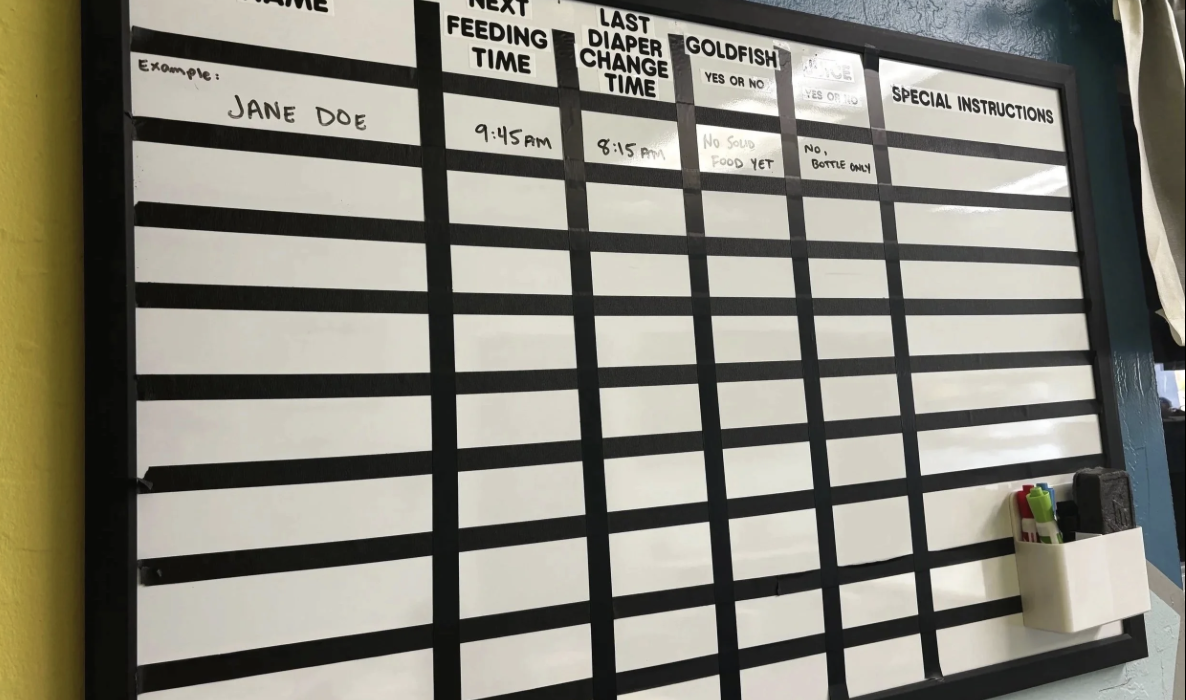
WHITEBOARD
Each classroom has a whiteboard with questions to ask parents during child drop-off. Please ask all of the questions listed on the whiteboard and record the appropriate information for every child.
This information helps you know important details about the child, including:
Feeding times
Allergies
Special instructions
Other important information provided by the parent
Take a moment to review the information before the parent leaves so you understand how to best care for each child.
CRYING AT DROP-OFF
It is normal for some children to cry when their parent leaves. If a child is crying at drop-off, ask the parent:
“How long would you like me to allow them to cry before contacting you?”
Respect the parent's wishes. If the child continues crying beyond the amount of time requested by the parent, contact a staff member. The staff member will then contact the parent.
policies
SAFETY POLICIES
REMAIN IN THE CLASSROOM
If you need to leave the classroom for any reason, please notify a member of staff.
A child is not allowed to be taken out of the classroom except by a member of staff or their parent/guardian.
CHILD INJURY
If a child is injured in any way, including a bite, bumped head, or paper cut, please notify a staff member.
EMERGENCY
In the case of an emergency, use the radio to dispatch a member of staff or the Safety Team.
FIRE ALARM
If the fire alarm goes off, carry all babies to the parking lot and find a member of staff.
Do not release a child to a parent without the pick-up tag.
LOCKDOWN
If a lockdown occurs:
Lock the doors.
Close the windows.
Turn off the lights.
Quiet the children.
Do not unlock the doors for any reason.
Staff members will have a key to unlock the doors once the lockdown is over.
CRYING CHILD
We have a 10-minute rule in our ministry.
If a child cries for more than 10 minutes, or earlier if a parent requests, please contact the Early Childhood Coordinator.
TOY SANITATION
Toys are deep cleaned weekly.
If a child dirties a toy during service, please place it in the black bucket under the sink.
We ask that the 10:30 AM volunteers put all toys in the bucket at the end of service.
NOTIFYING PARENTS
If you need to notify a parent during service for any reason, please contact a member of staff.
Staff will then contact the parents via text message, phone call, or by presenting their unique 4-digit code, found on the child's tag, on the screens in the Main Auditorium.
CHILD PICK-UP
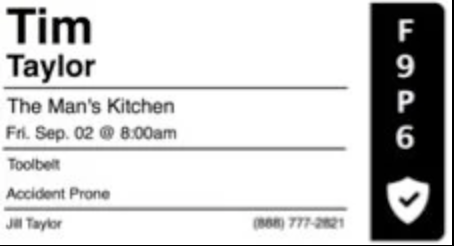
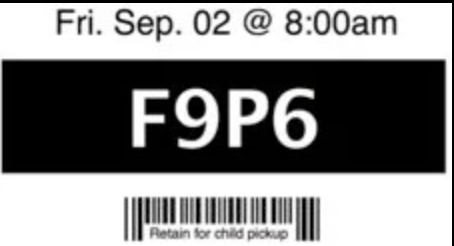
MATCHING NAME TAGS
When a child is being picked up, ensure that the parent's pick-up tag matches the child's name tag.
Verify that the 4-digit code matches and remove the child's name tag from their shirt.
You can then place both the parent tag and child name tag in the trash.
COLLECTING THE CHILD'S BELONGINGS
Before the end of service, collect all of the child's belongings and place them on the hooks near the door.
COMMUNICATING WITH PARENTS
Upon child pick-up, communicate with the parent any important information from their child's experience that day.
This includes:
Diaper changes
Feedings
Behavior
Etc.
WHAT IF A PARENT LOSES THEIR PARENT TAG?
Contact the Early Childhood Coordinator or the Life Kids Director.
The parent's ID will be checked with the “Trusted People” we have in our database.
EXAMPLE OF CHILD NAME TAG
EXAMPLE OF PARENT TAG
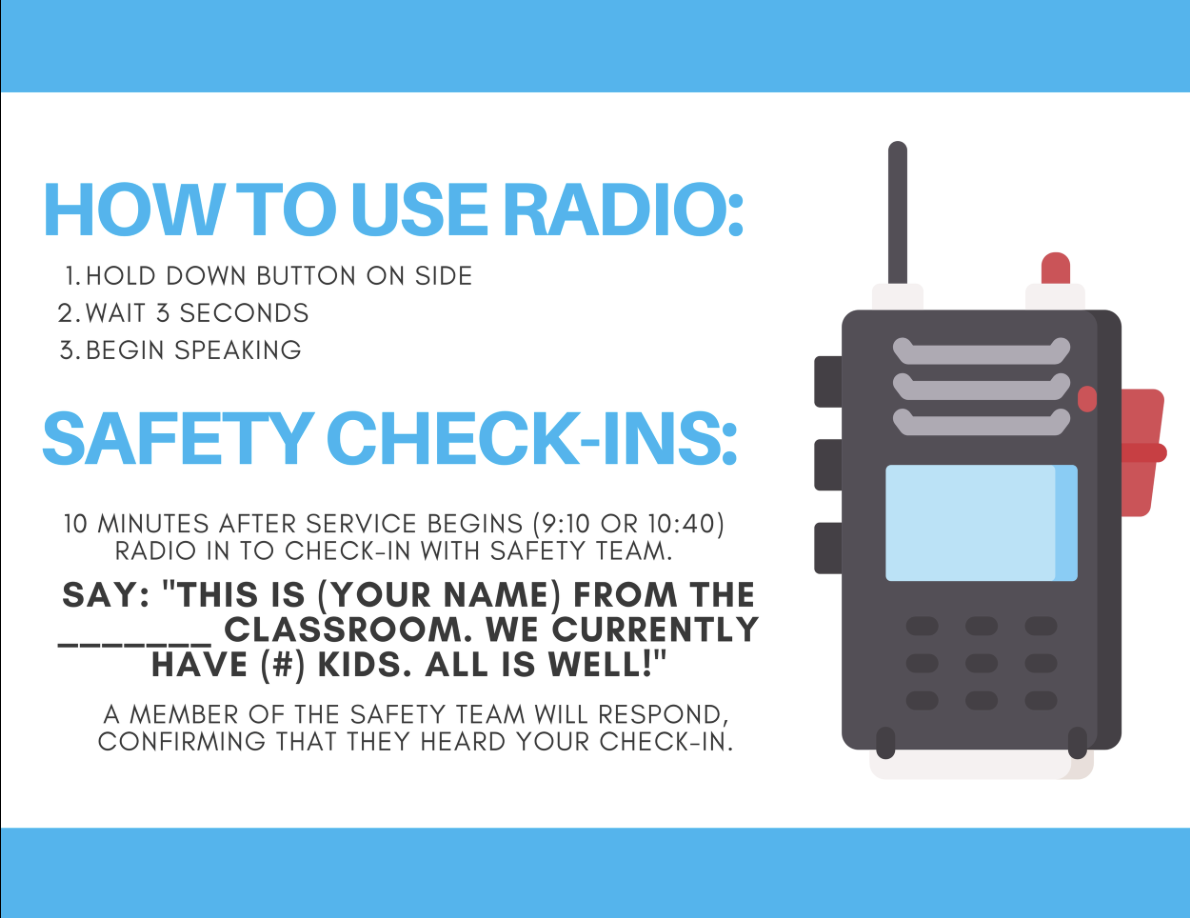
EXAMPLE OF SAFETY CHECK IN “SCRIPT”
SAFETY CHECK-INS
WHAT ARE SAFETY CHECK-INS?
Safety Check-Ins occur approximately 10 minutes after the start of each service.
During Safety Check-Ins, one teacher in each classroom will pick up the classroom radio and read off a script to our Safety Team, checking in and notifying them of how many kids you have in your classroom.
WHY DO WE DO SAFETY CHECK-INS?
New Life has been blessed with an incredible Safety Team that strives to serve our Life Kids Ministry.
The goal of Safety Check-Ins is to:
Establish good communication with our Safety Team.
Grow your comfort with using the radio in case of an emergency.
Allow the Life Kids Ministry staff to have awareness of the condition of your classroom before your teaching time begins.
classroom management
CHOICE-BASED INSTRUCTION
Whenever possible, give children choices. Providing choices can increase a child’s willingness to participate in the activity you have planned.
The goal is to keep children engaged and happy while still helping them follow directions and the classroom schedule.
For example:
“Okay, it’s time for us to do the Wonder Box. We can sit on the carpet or at the tables to explore what is in the box. Which would you prefer?”
When offering choices, make sure both options are choices you are comfortable with the child making.
HOW TO GAIN AND KEEP ATTENTION
Children’s attention spans are limited, but their attention can be gained and maintained through intentional connection and engagement.
Here are a few ways to gain and keep a child’s attention:
Use the child’s name.
Make eye contact.
Engage the child in ways that are interesting to them, such as their favorite toys, activities, or interests.
Be yourself.
Be silly with them.
Allow children to lead some conversations.
Remember that you and the children are CO-LEARNERS. This means that children will learn from you, but you can also learn from them.
Give children opportunities to teach you something. Tell them that you are confused about something and ask them to explain it to you. You may learn something you did not know before while also gaining the child’s trust in the process.
CHILD MISBEHAVIOR
NATURAL CONSEQUENCES
A natural consequence is something that happens naturally, without adult interference.
For example:
When you stand in the rain, you get wet.
When you don’t eat, you get hungry.
When you forget your coat, you get cold.
Natural consequences may occur in the classroom in ways such as:
“If you choose to not eat your snack, you may be hungry later.”
“If you choose to sit by yourself, you won’t be able to have fun with your friends.”
“If you continue to play with your water, you may spill and make your shirt wet.”
When informing a child of a natural consequence, it is important to give them an alternative choice. For example:
“Hey Jimmy, if you continue to play with your water, you may spill and make your shirt wet. Instead, would you like to put your water cup in the trash can or over here on the table?”
LOGICAL CONSEQUENCES
Logical consequences are the outcomes that result from a child’s actions involving other people or property. Following through on logical consequences means that the adult guides the child to take responsibility for any harm caused or damage done. The intent is to teach children that every action has a reaction.
Logical consequences may occur in the classroom in ways such as:
“If you choose to hit a friend, then you will have to sit with the teacher until you can have a safe body.”
“If you say something mean to a friend, you have to say that you’re sorry.”
“If you don’t sit quietly, you won’t be able to do the Wonder Box with us.”
When informing a child of a logical consequence, it is important to again give them an alternative choice.
For example:
“Hey Jimmy, if you don’t sit quietly, you won’t be able to do the Wonder Box with us. Would you like to sit quietly next to me or Miss Hannah?”
PROBLEM SOLVING
Children are great problem solvers and want to have the power to help come up with solutions. This can be especially helpful when addressing a large group. Rather than always giving children the solution, give them an opportunity to think through the situation and help determine what an appropriate solution or consequence might be.
For example:
“I noticed that many of our friends were running in the classroom. That is not safe. What do you think should be a consequence for friends if they run in the classroom?”
UNSAFE BEHAVIOR
When a child is performing unsafe behavior, it is important to correct that behavior quickly and clearly. If there is a safety concern, use the following format:
“You may not… (safety concern). You may… (safe choice). Would you like help or can you do it on your own?”
For example:
“Jimmy, you may not stand on the chair. You may sit in the chair though. Would you like help or can you do it on your own?”
If a child continues to conduct themselves in unsafe behaviors, please contact the Early Childhood Coordinator.
CRYING / NERVOUS CHILD
CRYING CHILD AT DROP-OFF
If a child is having a difficult drop-off, one teacher can stand outside the classroom with the door open and talk with the child. The goal is to gain their trust. Talk with the child about some of the fun things that are in the classroom. Invite them to take a look around and see if there is anything fun they would like to play with.
CHILD CRYING IN THE CLASSROOM
If a child is crying in the classroom, take them to the safe space in the classroom. Ask the child if they would like you to stay with them or if they would like some space.
IF THEY WANT SPACE
You could say:
“Okay, I will give you some space. I’ll be right over here if you change your mind and want me to come back.”
Check in with the child every so often. Ask if they need another minute alone or if you can sit with them. Allowing the child to have some control over the situation can help them feel safe and secure in the classroom.
If you need assistance, call the Early Childhood Coordinator.
IF THEY WOULD LIKE YOU TO STAY
Here are a few things you could say:
“I’m sorry that you are feeling sad. It’s okay to feel that way. I’m here with you.”
“Would you like a hug?”
“I get sad sometimes too. When I get sad, I take some deep breaths. Would you like to take a few deep breaths with me? Let’s do three.”
“Would you like to wrap up in the blanket and read a story?”
“Would you like me to bring us some toys?”
If the child is sitting in your lap, try taking a few deep breaths. Make your breathing loud enough that the child can hear it. They will feel your belly moving up and down, and they will likely mimic your movements. If you need assistance, call the Early Childhood Coordinator.
AFTER 10 MINUTES
If, after 10 minutes, the child is still not able to calm down, call the Early Childhood Coordinator.
Completion of online training
This online training will continue to be a reference for you throughout the entirety of your serving career in the Life Kids Ministry.
If you have any questions about the Life Kids Ministry, please contact the Early Childhood Coordinator or the Life Kids Director.
THANK YOU!
Thank you for completing this online training.
We appreciate your commitment to the Life Kids Ministry and are so grateful for your investment in the next generation of Christ-followers.
Please acknowledge your completion of the online training by filling out this form.